 Add to Chrome
 Add to Firefox
 Add to Edge
Quantifying and Optimizing Simplicity via Polynomial Representations
May 28, 2026
Deep networks often exhibit a preference for "simple" solutions, and such a simplicity bias is widely believed to play a key role in generalization. Yet a broadly applicable, quantitative measure of simplicity remains elusive. We introduce polynomial representations as a distribution-aware, low-dimensional surrogate for neural functions: we approximate a network's predictive behavior along data-dependent interpolation paths using orthogonal polynomial bases, yielding a compact functional representation. We show that the effective degree of this representation serves as a practical simplicity metric that is predictive of generalization across tasks and architectures, and consistently outperforms existing generalization proxies such as sharpness. Finally, polynomial representations naturally yield a differentiable simplicity regularizer, which consistently improves generalization in image and text classification, fine-tuning contrastive vision-language models, and reinforcement learning.

Robust Frequency-Calibrated Virtual EEG Channel Generation from Four Frontal Electrodes for Wearable EEG Augmentation
May 28, 2026Low-channel wearable electroencephalography (EEG) is attractive for long-term monitoring, but four frontal electrodes provide only a sparse and spatially biased view of distributed scalp activity. We present FAVC-Net, a compact frequency-calibrated virtual-channel network that generates 13 unmeasured EEG channels from Fp1, Fp2, F7, and F8. The model combines shared multi-scale source encoding, source-state embeddings, target-conditioned signed source-block mixing, GATv2-based attention refinement, attention-consistent skip fusion, and weak Welch power spectral density calibration. Rather than treating sparse-to-dense EEG generation as a purely waveform-matching task, the framework jointly emphasizes amplitude fidelity, spectral allocation, channel-frequency texture, and robustness to corrupted wearable inputs. On the PRED+CT dataset, FAVC-Net achieved the best joint waveform-spectral operating point among neural and interpolation baselines. Its time-domain gains were modest, whereas log-spectral distance and PSD KL divergence were reduced by 30.09% and 37.98% relative to the strongest non-FAVC comparator. Under wearable-like source perturbations, the model preserved spectral fidelity and resisted spectral collapse. These results support virtual EEG channel generation as a dual-domain augmentation problem, while emphasizing that generated posterior and parietal channels should be interpreted as frequency-calibrated representations derived from sparse frontal measurements rather than as independent physical recordings.
MEEG and AT-DGNN: Advancing EEG Emotion Recognition with Music and Graph Learning
Jul 08, 2024Recent advances in neuroscience have elucidated the crucial role of coordinated brain region activities during cognitive tasks. To explore the complexity, we introduce the MEEG dataset, a comprehensive multi-modal music-induced electroencephalogram (EEG) dataset and the Attention-based Temporal Learner with Dynamic Graph Neural Network (AT-DGNN), a novel framework for EEG-based emotion recognition. The MEEG dataset captures a wide range of emotional responses to music, enabling an in-depth analysis of brainwave patterns in musical contexts. The AT-DGNN combines an attention-based temporal learner with a dynamic graph neural network (DGNN) to accurately model the local and global graph dynamics of EEG data across varying brain network topology. Our evaluations show that AT-DGNN achieves superior performance, with an accuracy (ACC) of 83.06\% in arousal and 85.31\% in valence, outperforming state-of-the-art (SOTA) methods on the MEEG dataset. Comparative analyses with traditional datasets like DEAP highlight the effectiveness of our approach and underscore the potential of music as a powerful medium for emotion induction. This study not only advances our understanding of the brain emotional processing, but also enhances the accuracy of emotion recognition technologies in brain-computer interfaces (BCI), leveraging both graph-based learning and the emotional impact of music. The source code and dataset are available at \textit{https://github.com/xmh1011/AT-DGNN}.
Exact and Efficient Unlearning for Large Language Model-based Recommendation
Apr 16, 2024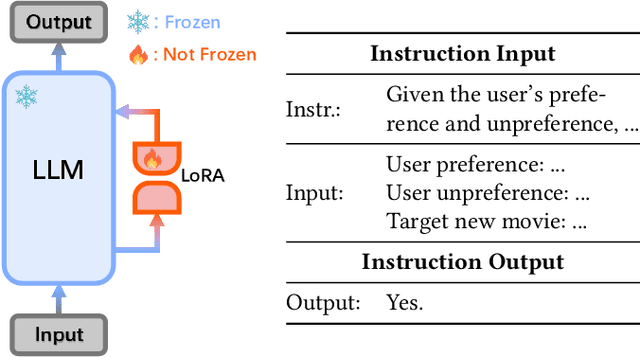
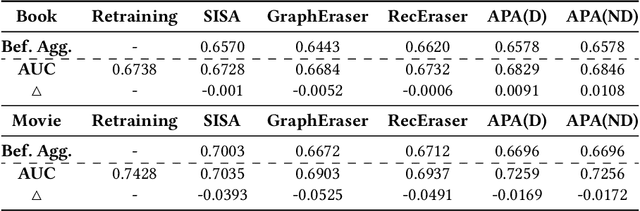
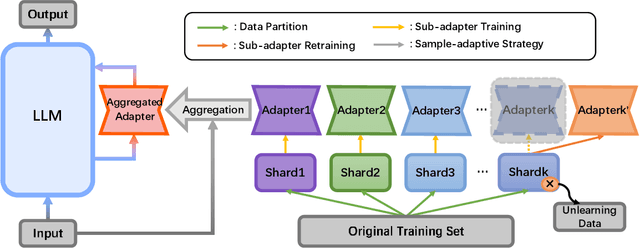
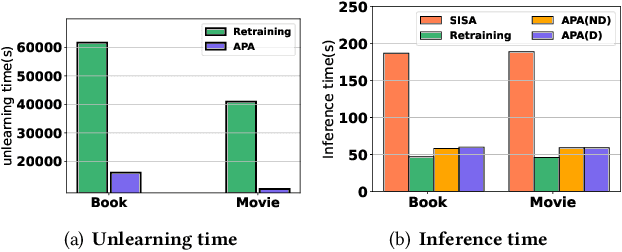
The evolving paradigm of Large Language Model-based Recommendation (LLMRec) customizes Large Language Models (LLMs) through parameter-efficient fine-tuning (PEFT) using recommendation data. The inclusion of user data in LLMs raises privacy concerns. To protect users, the unlearning process in LLMRec, specifically removing unusable data (e.g., historical behaviors) from established LLMRec models, becomes crucial. However, existing unlearning methods are insufficient for the unique characteristics of LLM-Rec, mainly due to high computational costs or incomplete data erasure. In this study, we introduce the Adapter Partition and Aggregation (APA) framework for exact and efficient unlearning while maintaining recommendation performance. APA achieves this by establishing distinct adapters for partitioned training data shards and retraining only the adapters impacted by unusable data for unlearning. To preserve recommendation performance and mitigate considerable inference costs, APA employs parameter-level adapter aggregation with sample-adaptive attention for individual testing samples. Extensive experiments substantiate the effectiveness and efficiency of our proposed framework